
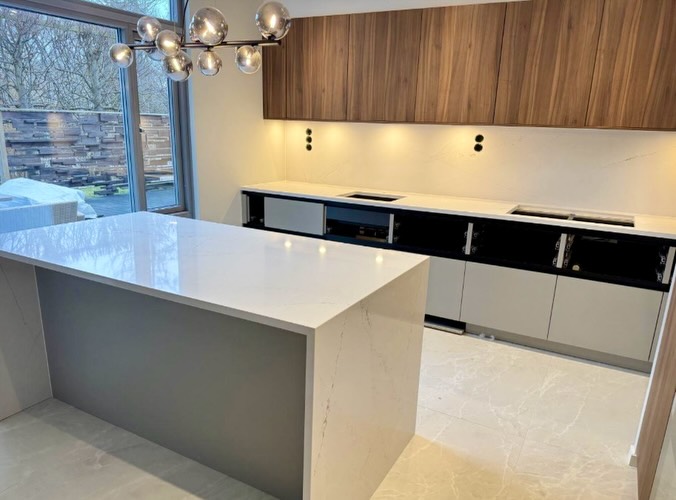
Choose Silestone with both colour and everyday use in mind. Photos of customers’ kitchens show how the surface works with the sink area, hob, wall and daylight. These details often determine the right finish and colour.
Daily and deeper cleaning
Start with Q-Action, or water and neutral soap. For tougher stains, there are clear steps below.
Everyday cleaning
Cosentino recommends Q-Action. If you do not have it, use water and neutral soap. Rinse with plenty of water and wipe dry with kitchen paper or a clean cotton cloth. Use a non-scratch cleaning sponge if needed. That is enough for daily care.
Grease and stubborn stains
Use Q-Action or washing-up liquid for grease. For stubborn stains, leave Q-Action or a similar product on for 2 minutes, scrub with a soft sponge, rinse and wipe dry. If the stain stays, contact us. Do not use solvents or acetone.
Limescale, spills and scuff marks
How to deal with limescale, sticky spills and marks without damaging the surface.
Limescale and hard water
Cosentino recommends cleaning vinegar for limescale. If the mark remains, a descaler diluted with water can be used for no more than 2 minutes. Rinse with plenty of water and wipe dry. Protect the sink and tap from products they cannot take, and do not mix cleaning products.
Spills that harden
Food: wipe with water and neutral soap and a wet cloth. Silicone and sealant: remove straight away with a knife held flat against the surface and Clean Colorsil, scrub with a blue sponge, rinse and wipe dry. Paint and nail varnish: do not use paint stripper or nail varnish remover with acetone; treat them as stubborn stains above. Never cut directly on the surface. Grey marks can be washed off with soap and warm water.
Strongly coloured stains
Coffee, tea, wine and food colouring: leave a cleaner with no more than 5.5% hydrogen peroxide on for 10 minutes, then wipe with a damp sponge. Do not use solvents such as white spirit or thinner.
Protect the surface (chemicals to avoid)
The chemicals below are listed as risks. Avoid them and the shine will last.
Chemicals to avoid
Nail varnish remover with acetone, permanent markers and ink, paint strippers and products with methylene chloride, strongly alkaline oven cleaners and degreasers for ovens and grills, caustic soda and other products with a pH above 10, chlorine-based products, hydrofluoric acid, drain-unblocking acids, degreasers with a high mineral content and strong hydrochloric acid or sodium hydroxide solutions. Do not use water repellents, sealers or polishes. If any of these is spilt, remove it straight away with plenty of water and neutral soap. Cosentino says such products can void the product warranty.
If bleach or a solvent gets on the surface, rinse with plenty of water and never leave it there. Do not use scouring products, scrubbing brushes or sponges with abrasive particles, or any cleaners that contain minerals or micro-particles.
Heat and UV
Put nothing that gives off heat or has just come off the hob directly on the surface. Use a trivet for pans, slow cookers and electric griddles until they have cooled. Do not place Silestone outdoors or where the surface is exposed to strong UV light.
Water, weight and edges
Do not leave water standing on the surface, especially near the sink and above a dishwasher or washing machine, where moisture and heat together can affect the surface. Do not put heavy objects on the worktop that it is not made for. Avoid knocks to the edges: damage from knocks is not covered by the product warranty.
Frequently asked questions
What is best for everyday cleaning?
Q-Action or water and neutral soap with a microfibre cloth, then rinse and wipe dry. A non-scratch cleaning sponge is fine for grease marks.
Can I use bleach?
Avoid it. Cosentino advises against chlorine-based products and gives a cleaner with no more than 5.5 % hydrogen peroxide for strongly coloured stains such as coffee, tea and wine instead. If bleach does get on the surface, rinse with plenty of water.
Can I put hot pans straight on it?
No. Do not put pans, pots or anything else that gives off heat or has just come off the hob directly on the surface. Use a trivet or mat, preferably rubber, until it has cooled. The large temperature difference can damage the surface.
Do I need polish or a water repellent?
No. The lustre is natural, and water repellents or polishes only give a temporary shine. Skip them.