
Copenhagen 5 April 2022
Kitchen worktop in Silestone Lagoon, København
A kitchen island and a run of worktop in polished Silestone Lagoon, a light cream-white quartz composite with subtle smoky-grey veining, in a kitchen in København. The worktop along the wall has an upstand, a hob cut-out and an undermount sink with a separately drilled tap hole.
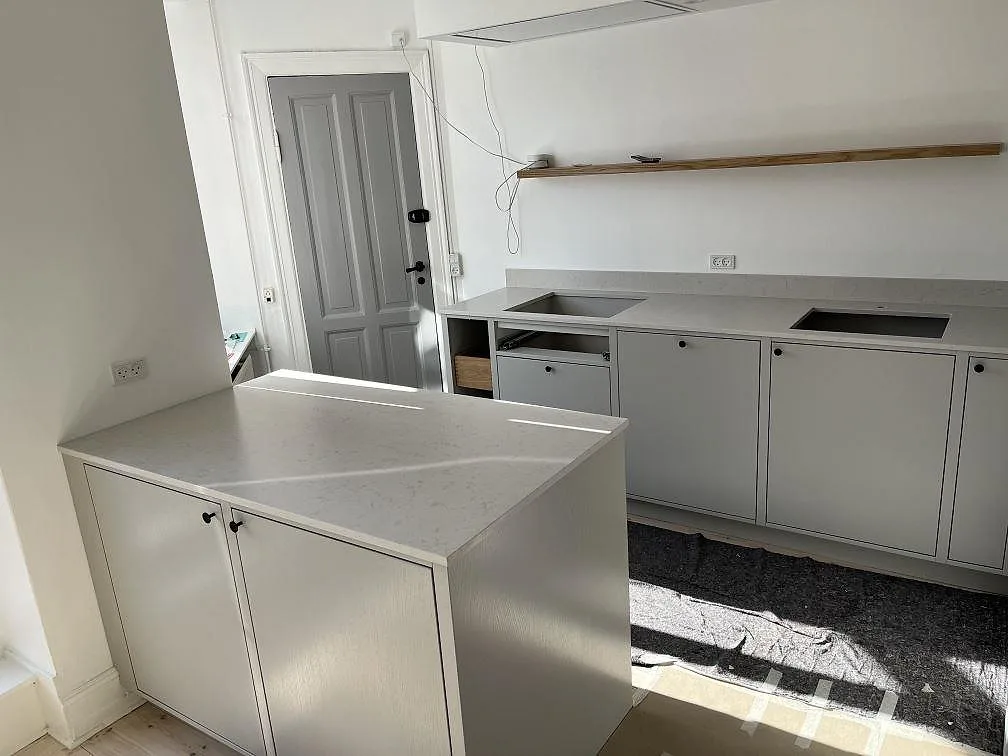
For this project in København, we installed a kitchen island and a run of worktop in Silestone Lagoon, a light cream-white quartz composite with subtle smoky-grey veining and a polished surface. The island has a side panel extending down towards the room, and along the wall runs a worktop with an upstand, a hob cut-out and an undermount sink with a tap hole drilled separately in the stone.
About the material
Silestone Lagoon is a quartz composite. Its tone is light cream-white, with understated veining that seems to float across the surface, creating a calm worktop without a pronounced pattern. The material is dense and absorbs virtually no liquid, so it does not need sealing to withstand everyday kitchen use.
This installation
The worktop along the wall accommodates the sink and hob for kitchen tasks, while the island provides an open space for working and socialising in the middle of the room. The undermount sink sits beneath the stone so that the edge of the slab runs straight down into the sink, and the separate tap hole is prepared beside the cut-out. The upstand protects the wall behind the worktop.
Care advice
Wipe the worktop with mild washing-up liquid and a soft cloth; the dense surface does not let stains penetrate. Bear in mind that quartz composite is sensitive to heat and can be damaged by high temperatures, so always place hot saucepans and baking trays on a heat-resistant mat rather than directly on the stone.
Worth knowing
A polished surface gives Lagoon its gentle sheen but shows wipe marks and fingerprints more readily than a matt finish, which a quick wipe will remedy. Avoid harsh or abrasive cleaning products, and use a chopping board so that knives meet the board rather than the stone surface.


